Showing posts with label Luxury Car. Show all posts

Thursday, July 14, 2016

2016 Kia K900 Review

Many, many miles have been driven down the highway since Kia arrived bringing its vehicles to the roads of the U.S. more than two decades ago. In June of this year J.D. Power recognized the brand as the highest scoring nameplate in its 2016 Initial Quality Study (IQS) out of all 33 makes in the U.S.  This marked the first time in 27 years that a non-premium brand has topped the rankings.

Kia now sells over 600,000 vehicles a year in the U.S. and has become a benchmark in many vehicle segments.

Kia’s top-of-the-range K900 4-door luxury sedan first appeared in 2015 with its V8 power, rear wheel drive, good looks, refined interior, and lots of comfort and smoothness. I drove that model about a year and a half ago and have been looking forward to a revisit.

PHOTO (select to view enlarged photo)
For 2016 a V6 engine is now offered, in addition to the V8. The K900 now comes in three models - the Premium V6 priced at $49,000, the Luxury V6 priced at $54,900 and the Luxury V8 at $61,900.

When I drove the 2015 Kia K900 with V8 power, word was already out that the V6 would be coming. The V8 performs very well and will accelerate from stop to 60mph in about 5.7 seconds. Although some competitive luxury models have quicker times, the K900 V8 is no slouch. An under-six second zero to 60 is plenty for the average driver.

On this go-round I drove the Luxury V6. Power output is 311 HP coming from a 3.8L DOHC. That’s mated to an eight-speed automatic driving the rear wheels. Published reports peg zero to 60 mph at around the 6.2 second mark. By the way the V8, a DOHC 5.0-L, makes 420HP.

For 2016 there’s been a few updates on the outside with a new grille up front and at the rear there’s updated chrome trim, exhaust pipes, taillight design and a new bumper. A new smart power trunk opens the trunk automatically when the key fob is sensed in your pocket or purse near the deck lid for more than three seconds.
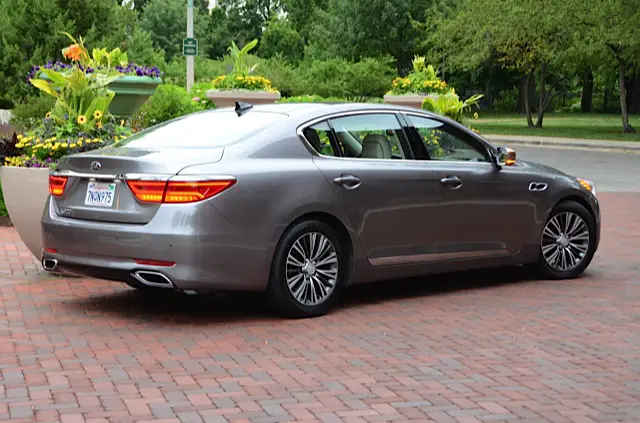
PHOTO (select to view enlarged photo)
The availability of Autonomous Emergency Braking (AEB) is another big advancement. It utilizes the front camera and Advanced Smart Cruise Control system, which adjusts vehicle speed to help maintain a set distance to the vehicle in front, and has the ability to bring the K900 to a full stop. More and more we see driver-assistance safety features being added to all new vehicles. This is not about autonomus car technology but safety items that are driver aids and will help keep you from an accidental collision.

As it goes in the world of new vehicle news I needed to drive from Chicago to Ann Arbor, MI to visit another car maker. Road trips are always a good way to get to know a vehicle. I’m now slouch on the highway but midweek travel on the interstate always will include lots of semi-trucks that influence the pace. My drive east had its share of slowdowns and re-accelerations. In spite of that, the K900 got 30mpg on the 70mph speed limit interstate. This certainly came as a surprise considering the EPA test-cycle highway rating for the V6 is 26 mpg. On my return leg I could move faster and with a more constant speed and got 31 mpg.

I’ve heard from some of my colleagues who have driven the V6 K900 that they have had similar low fuel consumption experiences on the highway. The EPA test-cycle city rating is 17 mpg and the overall combined is 20 mpg. For comparison the V8 has EPA test-cycle ratings of 23 highway mpg, 15 city mpg and 18 mpg combined.


So what kind of luxury do you get with the K900? Well, beyond the standard leather interior, navigation system, and large sunroof there’s a front and rear camera display, front and rear parking sensors, heated and ventilated front sears, heated rear seats, power adjusting steering column, heated steering wheel, a rear seat center console with climate and seat controls, side and rear window sunshades and more.
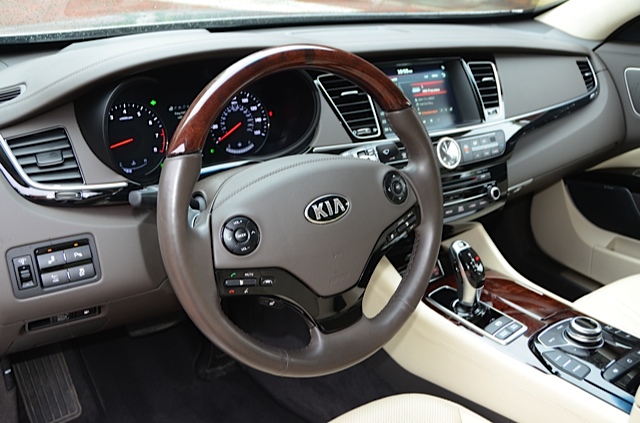
PHOTO (select to view enlarged photo)
A $5000 VIP package that was on my media-loaner includes head-up display, automatic emergency braking, blind spot detection, lane departure warning, rear cross traffic alert, smart cruise control, power headrests, power lower cushion extension on the drivers seat, and power reclining rear seats that are also ventilated.
There’s lots of equipment to keep you safe and pamper you too. There even are soft-close power door latches and a chauffeur switch for the front passenger seat…to move the seat forward so you have lots of rear legroom.

All-in-all the K900 is one very nice ride. It’s high on comfort and luxury features, has good overall performance while not being in the sports sedan category. The V6 model is equipped with 245/50R18 tires that provide good dynamic behavior and yet are not too harsh riding. The V8 has staggered tire sizes with 245/45R19 up front and 275/40R19 in the rear that can be a bit firm-riding with their low profile.

There’s no news on whether we’ll see all-wheel drive on the K900. That being the case, I would suggest using winter tires on all of the three models if you live in a snowy-winter area.
PHOTO (select to view enlarged photo)

Monday, June 20, 2016

Kia K900 sedan brings value

WASHINGTON — When shopping for a luxury car, I’m going to guess, the Kia dealer isn’t at the top of mind. But the Kia K900 adds a new page to the automakers’ playbook, and it’s bringing value to the large luxury sedan market — something Kia has done in other segments of the marketplace.
Large luxury sedans are pricey, usually near the six-figure mark. Kia is a relative bargain, with a starting price around $55,000 for a six-cylinder model that’s new for the 2016 model year. The new engine does fine for this car. It’s not a powerhouse, but it goes well with the laid-back attitude of a large luxury sedan.

I didn’t have a problem keeping up with traffic or passing when needed. That said, don’t think that this is a sporty luxury sedan, because it’s not; it doesn’t like to be pushed. The K900 is made for quiet road trips and relaxed commutes.
I drove this car for five or six hours at a time and was surprised by how quiet it was. It has to be one of quietest cars out there. My car had the advanced smart cruise control, which works well at keeping a safe distance from the car ahead without being jerky with the brakes. The fuel economy for the week was 26 mpg, which is better than the sticker, but I’m sure the highway travel really helped.
The interior has all the makings of what a luxury car should be — lots of space, real wood trim and loads of leather. The seats are comfortable upfront with nice quality leather. They’re maybe not quite as nice as some other large luxury sedans, but still good.
With the VIP package, the driver’s seat has seat cushion extenders, so longer-legged drivers can get some relief. That package also turns the back seat into a comfort zone, with power reclining, heated and ventilated seats and a ton of controls for audio and climate like a limo. The space in the back seat is plentiful and very comfy for two. There’s room for a third, but they will miss the comfort.
The interior trim is a soft touch and it looks and feels nice. Perhaps the buttons look a little cheaper than the competition, but they are large and easy to see and use. A central knob on the center console controls some menus; it can be a bit touchy, and there are a few too many steps for some operations. But the large nine-inch screen is easy to see and the NAV works well once you figure it out. There are front and rear cameras, which are helpful when parking this large sedan.
Styling outside is rather conservative and doesn’t draw too much attention. It has the right formula, including a large grill, HID lighting, a long hood and a long, almost stretched, look from the side profile. The 18-inch wheels fit the luxury look and stance. The rear-end styling is understated, but a nice dual exhaust system helps jazz it up. Pictures make it look smaller than it really is. In person, it’s a more commanding size, like the other luxury sedans on the road.
The 2016 Kia K900 is a solid large luxury sedan that won’t require you to break the bank to join the ranks of big luxury. With prices under $60,000, it might not be quite as nice as the competition, but it does rather well. And hey — you can still afford a second car so you don’t have to dirty your new luxury sedan in foul weather.

Tuesday, August 18, 2015

How Kia And Hyundai Infiltrated The Luxury Market

Remember the days when a Kia or a Hyundai were considered to be nothing more than knock-off Korean interpretations of Japanese cars? We’re not talking about anything in recent history of course, but instead one should think back to the archaic days of automatic seatbelts, cassette tape players, pop-up headlights, and Miami Vice-themed factory graphics. This was the age of Super Nintendo waging war on Sega Genesis, when Nickelodeon’s Guts could only be overshadowed by Double Dare, and as Pepsi Clear made its bubbly belly-flop into the annals of American soda-pop failures, something began to change in the way we looked at Asian cars.

People began to take Acura seriously, because while it may have been considered a disjointed Honda back in the day, the introduction of the NSX changed everyone’s opinion for the better. Lexus also was becoming a huge hit, as it showed Americans that all of the sophistication and quality one looks for in a German luxury car could be had for a fraction of the price thanks to Japanese engineering. So while Infiniti continued to convince buyers that its line-up was just as reliable as anything else in the Nissan range, Mazda and Subaru primarily stayed out of the luxury line, opting for all-wheel drive versatility and Miata-infused fun instead. Meanwhile Mitsubishi started sending us SUVs, while Isuzu and Suzuki tried desperately to get our attention, but got very little in return.

While Japanese automakers fought amongst themselves, and American manufacturers began to fret over the permanence of this Japanese invasion, no one seemed to notice that Korean commuter cars were starting to catch on. No one was giving Hyundai or Kia the time of day, and why should they? Neither of these brands were hot sellers, they certainly were not a part of the “Japanese invasion,” and there was not a single thing about them that was interesting, exciting, exuberant, or expensive.

But as time progressed it became apparent that this is exactly what these two companies wanted, because while they did have the means to launch luxury models at any time, they opted to play it safe, and build their presence here in the states from the ground up instead. It may have taken a couple of decades to do so, but today there is no denying the fact that Kia and Hyundai played their hands extremely well over the years, and what started off as a handful of compact economy cars has morphed into a full-blown takeover, with everyone from Mercedes-Benz to Honda feeling the heat, as Korean cars have gone from “crap” to “oh snap!”

What people need to understand is that while Kia and Hyundai may have started off with humble beginnings, drivers need to get over the predisposition that these are second-class Japanese knock-offs with questionable reliability and very few creature comforts. Sure, at one point it would be fair to assume such a thing, but if you read our review of the Hyundai Genesis, or look over the pictures we took of the $67,000 Kia K900, it becomes apparent that this is no longer the case.

In a article we did back in May, we highlighted seven reasons why Korean cars rock, and in this piece a few key pivotal moments in the history of the two car makers were touched upon, as they distanced themselves from the stigmas of old which have very little correlation to the cars you see today. Playing it conservatively over the years has allowed them to amass both wealth and resources, as both automakers now make the majority of their cars here in America.

While things were indeed going quite well for both firms after the turn of the millennia, it was not until 2004 that things really started to change, when Hyundai shocked the world by tying Honda for initial brand quality in a study conducted by J.D. Power and Associates. Hyundai then placed third in J.D. Power’s 2006 Initial Quality Survey, trailing only Porsche and Lexus, while Kia continued to win awards for its safety, design, and ingenuity in every segment imaginable.

This leads us back to what this entire diatribe is about: If you are nipping at Porsche and Lexus’ heels in J.D. Power’s quality surveys, then there has to be a sprinkling of sophistication in there somewhere. Take Hyundai’s Equus for example. Here is a 429-horsepower V8 luxury sedan, that has an interior that will make anyone say “BM-Who?” thanks to its cooled front and rear seats, rear-seat entertainment system with dual 9.2-inch monitors, and cabin that is bigger than a BMW 750i, a Mercedes-Benz S550, or the Lexus LS 460.

But perhaps the greatest thing about this car is that it carries with it the traditional Korean ace in the hole: an unbeatable price. For $68,750 you can buy a fully-loaded Equus for thousands less than the base version being offered by these other manufacturers, and if you sit in one you will notice that the quality of the materials used rivals those found in its competition. Sure, some people think driving a Korean car is beneath them, and that European is the only way to go for luxury, but these are the same close-minded individuals who are more worried about what other people think than what they want and need in a car. Honestly, if the Oxford fits and it costs a hell of a lot less than the rest, then lace that beauty up and rock it, man.

In closing, it’s notable that both Kia and Hyundai’s move on the luxury market comes without the formation of a separate brand in which to stable these posh chariots. Where other manufacturers have felt the need to create spin-offs like Lincoln, Buick, Lexus, Acura, Infiniti, and Audi, Korean automakers have opted to keep their more prestigious offerings singular in nature, while unashamedly harboring the same base-born nameplate on the rear of the car. Which is a very Korean thing to do, since the risk involved with launching a single luxury model is far less than that of an entire line-up. By keeping a recognizable badge on the back of their cars, these automakers are able to stop onlookers dead in their tracks, so that they may murmur to themselves, “Man, that Kia looks absolutely fantastic!”